01 / 01
Luigi Ceccarelli

Works

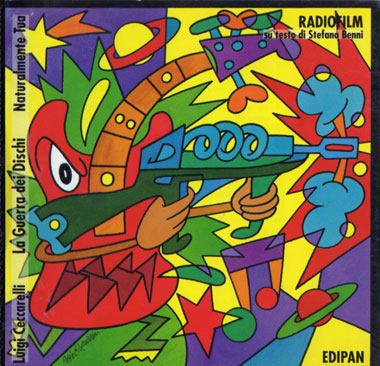
La Guerra dei Dischi (the War of the Records) [1994]

radio film for voices and sampled sounds
organized by computer

text by Stefano Benni
based on the novel "Terra!"

New Surround Version 2026
remixed and remastered

The year 2026 was a year to remember in the history of music.
No, no great singer was born, but many died.
There were resounding successes in the “Hit Parade”.
But above all, the year 2026 marked the end of the “War of the records”,
with the attack on the royal spaceship.
I was there, and I can tell you:
it was February 15th, and that evening he would be there
a great concert on King Akrab’s spaceship,
flying to Andromeda ……..

interpreters
main voices – Giovanna Mori – Coyllar, Mirella Mazzeranghi – Alice
other voices – Rosa Masciopinto, Fernando Fera, Marco Carlaccini, Giorgio Battistelli
Electric guitar – Fernando Fera

Edipan edition
duration: 34 ‘
commission: Rai Radio3
1st radio broadcast – RAI Radio3, November 1994

new surround version
Firenze, June 5 2026
Tempo Reale, Villa Strozzi/Globo

CD

La Guerra dei Dischi (The War of Records) – radio films
the CD also contains: Naturalmente Tua – ballet suite
total duration: 74 ’50 ”
1995
Compact Disc: Edipan CCD 3054

1 – Prologo
2 – Nell’Interno dell’Astronave
3 – Baby I’m a Rat Face (parte II)
4 – Concerti Clandestini
5 – Baby I’m a Rat Face (parte II)
6 – Mauna Loa Sound
7 – Gli Invisibili
8 – One e Eno
9 – Edgar Allan and The Poe
10 – Musica di Pillole
11 – Parsifal
12 – Micro Minstrel
13 – Le Dzunum
14 – La sede della One
15 – Concerto delle Dzunum (parte I)
16 – Lettera Commerciale
17 – Concerto delle Dzunum (paret II)
18 – Epilogo

From a distant and undefined future, the voice of Coyllar—leader of the band “Le Dzunum”—breaks the silence to recall the final, tense moments before the chaos: the tragic 2026 attack on the CalalbaKrab, the royal spaceship that killed the tyrannical King Akrab, ruler of the Arab-American-Russian empire. That night of blood and music becomes the trigger for the story of Alice, another key figure in Dzunum. With the raw emotion of someone who spent her youth on stage and in hiding, Alice takes us behind the scenes of the early 21st century, a golden age when legendary bands dominated the world stage. But behind the spotlight lies a cruel reality. Today, as then, art is merely a pawn in the hands of money. In a deadly, underground power game, the strings of the entire music industry are pulled by two record giants willing to do anything to destroy each other: One and Eno.

Review

Click here for the full review from Il Giornale della Musica

La Guerra dei Dischi  at Tempo Reale:
Stefano Benni, Luigi Ceccarelli, and the Return
of Sound Narration

by Stefano Bozolo (Il Giornale della Musica, June 7, 2026)

Forty-three years after the release of “Terra!” and thirty-two years after the making of the radio film La GUERRA DEI Dischi (The War of the Records), the tribute that Tempo Reale dedicated to Stefano Benni on June 5th in Florence […] brought to light a work surprisingly capable of speaking to the present.

Benni’s intuition was simple and brilliant. In the chapter “La GUERRA DEI Dischi” music becomes the terrain of an all-out clash between cultural industries, fan bases, commercial strategies, and media manipulation. What in 1983 seemed like a grotesque dystopia now takes on the flavor of a fulfilled prophecy: the attention economy, the polarization of listening communities, algorithms that fuel competing musical identities, and the transformation of aesthetic experience into a phenomenon of social belonging are now an integral part of our cultural landscape.

It is within this narrative environment that Luigi Ceccarelli’s work reveals its full originality. Born in 1994 as a commission from Rai Radio 3 as part of the “Radiofilm” project promoted by Roberta Carlotto, La guerra dei dischi belongs to a period of Italian cultural radio that today seems almost unrepeatable. During the introductory conversation with Francesco Giomi, Ceccarelli recalled how the fundamental requirement was to preserve the readability of the narrative. A seemingly simple request, but in reality, it went against the grain of a significant portion of the musical avant-gardes of the late twentieth century, which often focused on fragmenting the text, dissolving its narrative dimension to transform it into pure sound material. The aesthetic choice for the radio film was different: the story had to remain perceptible, not as a simple support for the music, but as a structural element of a complex compositional device.

Relistened to today, Ceccarelli’s work is striking precisely for its ability to inhabit a middle ground between theater, cinema, literature, and electronic music.

This is not a soundtrack in the traditional sense. The electronic materials do not accompany the narrative; they construct it. Voices are organized into polyphonic textures, dialogues are sometimes transformed into canons, mechanical repetitions take on dramatic value, and timbral transformations become actual scene changes. The sequences dedicated to the rivalries between record companies are particularly effective, where the accumulation of vocal and sonic iterations produces a ferocious comedy that perfectly reflects Benni’s poetics.

Ceccarelli’s electronics today seem almost surprising in their concreteness. In an era in which a significant portion of sophisticated electronic production seems to oscillate between algorithmic abstraction and self-referential technological sophistication, La guerra dei dischi reminds us that sound can be complex without sacrificing communication. This is a lesson worth discussing in the contemporary debate on the aesthetics of electronics.

In recent decades, the world of electronic art music has often emphasized research into the sound material itself: spatialization, synthesis, physical modeling, generative processes, artificial intelligence. These are all extraordinary developments, but not always accompanied by a similar focus on the construction of shareable forms and narrative imagery. The risk is that technology becomes the content of the work rather than its complex language.

Ceccarelli belongs to a generation of Italian composers who have followed a different path. Coming from theater, dance, film, and the visual arts, the composer has always conceived of sound as a relational element, a dramatic agent. In the radio film dedicated to Benni, technology is not exhibited but rather put at the service of a poetic construction. Electronics do not create distance; they generate proximity. They do not ask the listener to admire the device, but to enter into the story.

From this perspective, the re-presentation of the work in the immersive Tempo Reale system takes on a special significance. The sixteen speakers surrounding the audience are not used as a simple technological demonstration. On the contrary, they allow a quality already present in the original work to be perceived: its theatrical nature. Spatialization amplifies the scenic nature of the sound composition, bringing out details that remained implicit in the traditional radio format.

The result is paradoxical and fascinating: a work created in 1994 seems more relevant today than many recent productions. Not because it anticipates contemporary technologies, but because it proposes a conception of the relationship between sound and meaning that continues to question the present. In a historical moment in which artificial intelligence promises to generate music, voices, and soundscapes in potentially infinite quantities, the central question returns to the one that runs through Ceccarelli’s entire work: what does sound narrate? What human experience does it organize?

[…] This revival of La guerra dei dischi reminds us that electronic music can still be a space for critical imagination, storytelling, and worldbuilding. Not just a laboratory of techniques, but a form of thought. The encounter between Benni and Ceccarelli clarifies how technology becomes art not when it produces new sounds, but when it manages to imbue them with a narrative and human necessity.

Edison Studio - Privacy policy © EdisonStudio 2020.
All Rights Reserved.